Trump’s Illegal Invasion of Venezuela Forebodes an Environmental Disaster
Rebuilding Venezuelan oil production would produce new annual emissions higher than the carbon footprints of France, the UK, or Thailand
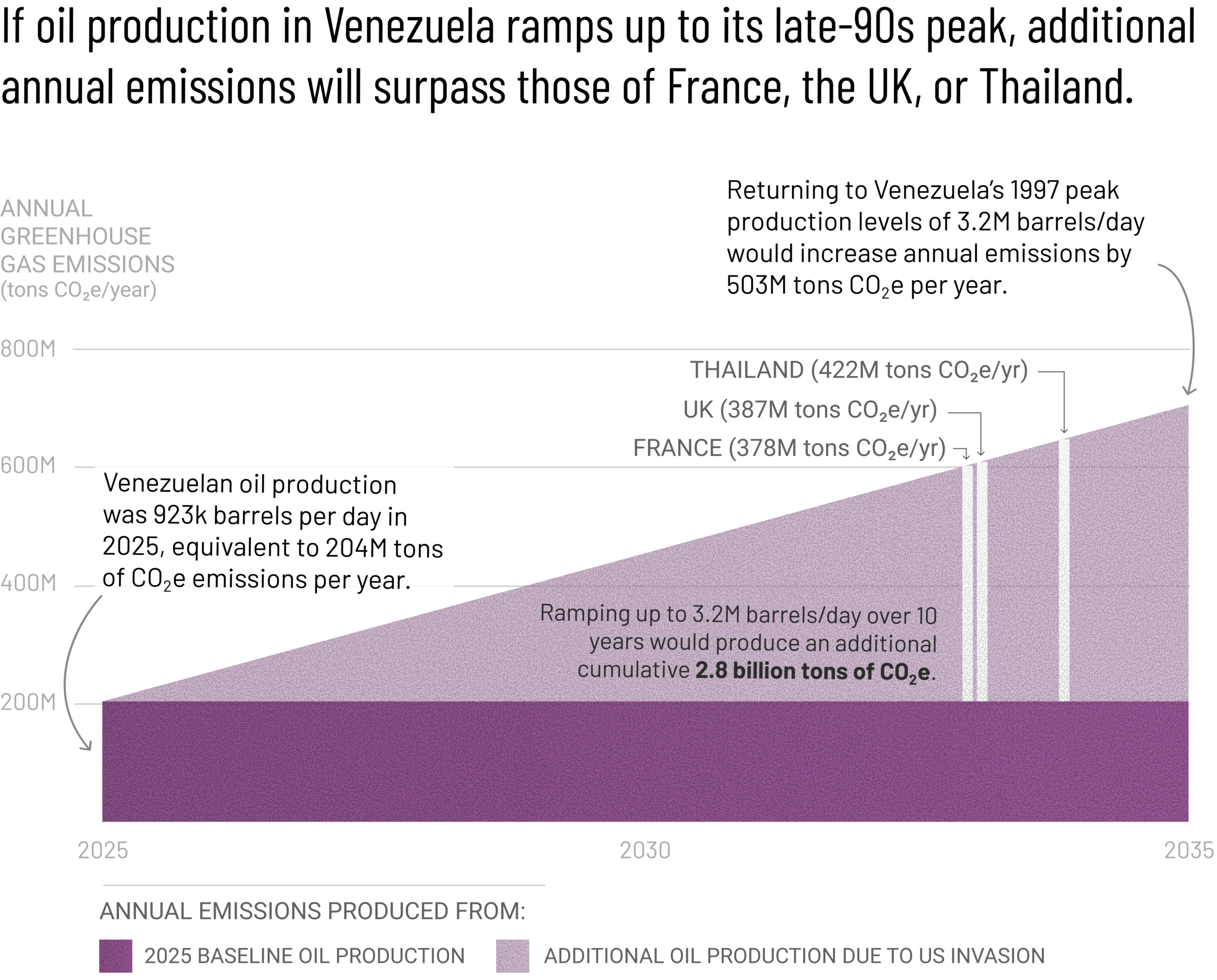
The US’s illegal invasion of Venezuela on January 3, 2026 exacerbates global instability, geoeconomic uncertainty, and accelerates atmospheric and biospheric breakdown. Returning Venezuelan oil production to 1990s peak levels would result in five hundred million tons of annual carbon dioxide emissions, a volume higher than the annual emissions of France, the UK, or Thailand.
Venezuela has the world’s largest proven reserves of oil, although that oil is of very low quality, making it energetically intensive to refine. Because of this, the oil causes climate harms as severe, or worse, than the Canadian tar sands and other ‘heavy’ sources, making it as much as 50 percent more emissions intensive than ‘lighter’ sources of crude oil, like those found in the US or Saudi Arabia. Venezuela’s oil production averaged 923,000 barrels per day in 2025. If the country took ten years to return to the 1997 peak of 3.2 million barrels per day preceding Hugo Chavez’s first election, it would result in an addition of:
- A cumulative 2.8 billion tons of CO2 equivalent emissions over the next ten years
- 503 million tons of additional annual CO2 equivalent emissions by 2035—more than the annual emissions of France (378M tons CO2e), the UK (387M tons CO2e), or Thailand (422 CO2e).
Rebuilding the Venezuelan oil sector under the control of US multinationals (likely possible only with massive US federal subsidies) would be an ecological catastrophe that will make virtually everyone in the world less secure by further turbocharging climate change. Whether or not the plan to “run” Venezuela and its oil industry results in a return to production at its 1990s level, this shows us that Trump’s foreign policy—of establishing an imperial sphere of influence governed by loyalty to the US and run on fossil fuels—is a threat to our planetary future.