The Homes Act
Every day, millions of people in the US struggle to find housing they can afford, and the climate crisis is making an already painful housing crisis even worse. The only way to resolve these interlocking issues is by developing a national green social housing agenda: a massive public investment in good homes and good jobs.
The Homes Act (Smith-MN and Ocasio-Cortez-NY), would establish a housing development authority to finance, repair, and build millions of beautiful, affordable, community-controlled, and climate- resilient housing units. This bill provides flexible options to fit the needs of communities—urban, suburban, rural, Tribal—across the country.
The Climate and Community Institute, Urban Democracy Lab at NYU, and Socio-Spatial Climate Collaborative at UC Berkeley have researched the design of this transformative policy and its impact on the housing and labor market. Read our:
- Analysis of the Homes Act legislation
- Policy brief on the Social Housing Development Authority
- Research on the need for green social housing at scale
Legislative Impact
Our analysis shows that, with an investment of $30 billion annually and a revolving loan fund, the Homes Act would enable:
- 1,390,000 new social housing units. Of those:
- 70 percent (973,000 units) would be affordable to low-income households. 556,000 units would be available at 0-30 percent Area Median Income, and 417,000 units would be available at 31-50 percent Area Median Income.
- 30 percent (417,000 units) would expand the supply of market rate housing.
- Up to 310,000 total jobs annually, including up to 160,000 direct well-paying union jobs in the building trades industries each year.
How it Works
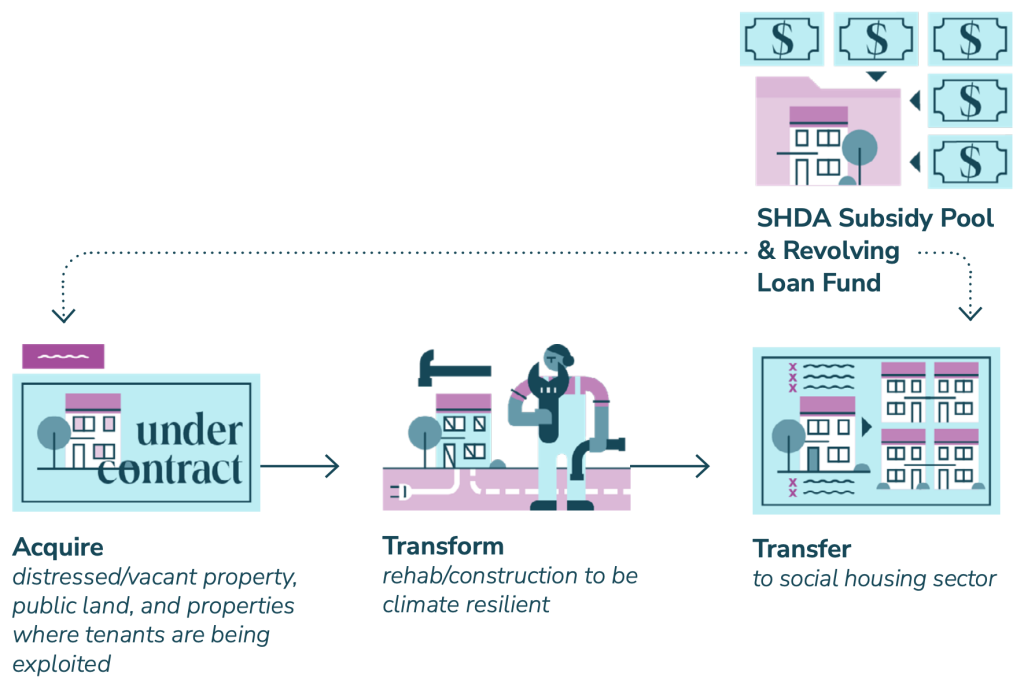
The Social Housing Development Authority (SHDA) is a proposal for a proactive public actor in the housing market to expand the supply of permanently affordable green social housing. This would be a federal entity that would serve the functions of a public developer, a public bank, and a land bank to create and transfer housing to the social housing sector.
A federal SHDA would leverage lending authority from the Treasury and appropriated funds for capital grants to purchase distressed real estate, vacant land, and properties where tenants are vulnerable to being exploited; transform these places into healthy and environmentally resilient homes; and transfer them to the social housing sector. This sector includes public entities like local governments and public housing authorities; non-profit housing providers; and tenant unions and associations. Rents would be kept affordable in perpetuity. These new housing options would put residents in greater control of their living conditions rather than subject to the whims of private landlords or banks.
Social Housing on the High Road
Housing costs are outpacing wages in every corner of the country. The Homes Act delivers for workers on two fronts: permanently affordable housing and high-quality jobs.
Permanently affordable housing for workers: Across the portfolio, 40 percent of units are for extremely-low income households making low wages, and 30 percent of units for low-income households. The remaining units are market rate but capped at 25 percent of a household’s gross income with guardrails on future rent increases. This gives every worker, regardless of their pay, a chance at stable housing.
High-quality jobs for workers: Our analysis shows that this proposal would generate up to 615,000 jobs annually, including 232,000 direct well-paying union jobs in the building trades industries each year.
To ensure the SHDA is empowering the working class, it would abide by strong labor standards, including explicit policy of neutrality and that workers are notified of their right to organize for all employees, eligible entities, contractors and subcontractors of the SHDA; Davis-Bacon and prevailing wage compliance; project labor agreements for larger projects; and mandatory recruitment from registered apprenticeships and underrepresented communities.
Social housing is a climate solution
Social housing can keep people stably housed amidst a mounting climate crisis and help decarbonize the building stock.
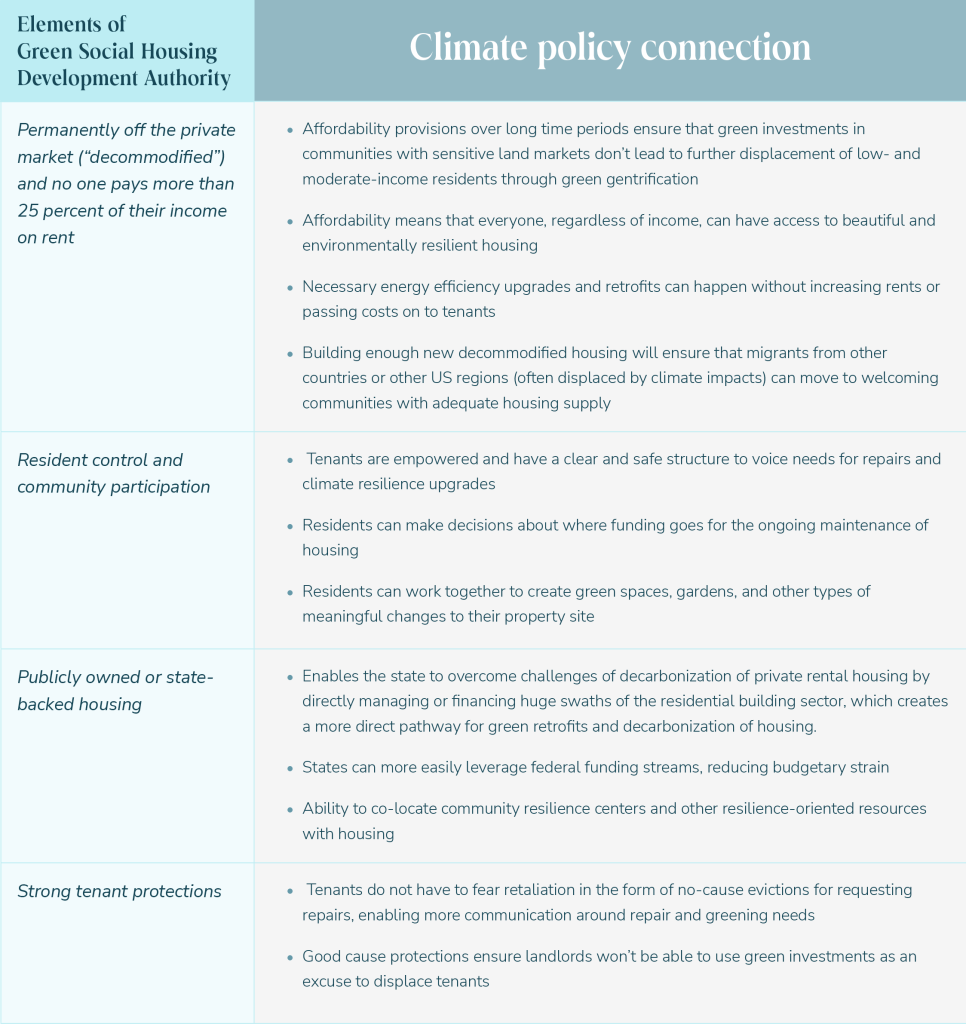
For more on social housing as a climate solution, see our research on Green Social Housing: Lessons from Vienna.