Labor of the US Military-Industrial Complex
Jobs in the military industry have declined even as the Pentagon budget soars, exposing a broken industrial model.
Despite record-high military spending now exceeding $1 trillion annually, the arms industry is producing fewer and lower-quality jobs. Once a source of stable, unionized manufacturing work, emerging trends across the sector are deepening conditions of stagnant job creation and declining wages. The capital-intensive nature of weapons production makes military spending one of the least effective ways for the federal government to create jobs, while the rise of defense-tech companies that aim to produce “attritable” weaponry in lean, automated factories is likely to further reduce employment. At the same time, these shifts highlight an opportunity to redirect public investment and industrial capacity toward civilian sectors that generate more jobs and greater social returns, including urgent priorities like green manufacturing and the energy transition.
This brief analyzes the current state of the arms industry — examining its workforce past and present, and assessing the implications of the changing nature of the companies that make up the sector. We find that:
- Employment at military contractors has plummeted over the past three decades: from an estimated 3.2 million workers during the Reagan military-spending peak in the mid-1980s to 1.1 million workers in 2020. The drop occurred despite Pentagon budgets rising 22 percent over the same period.
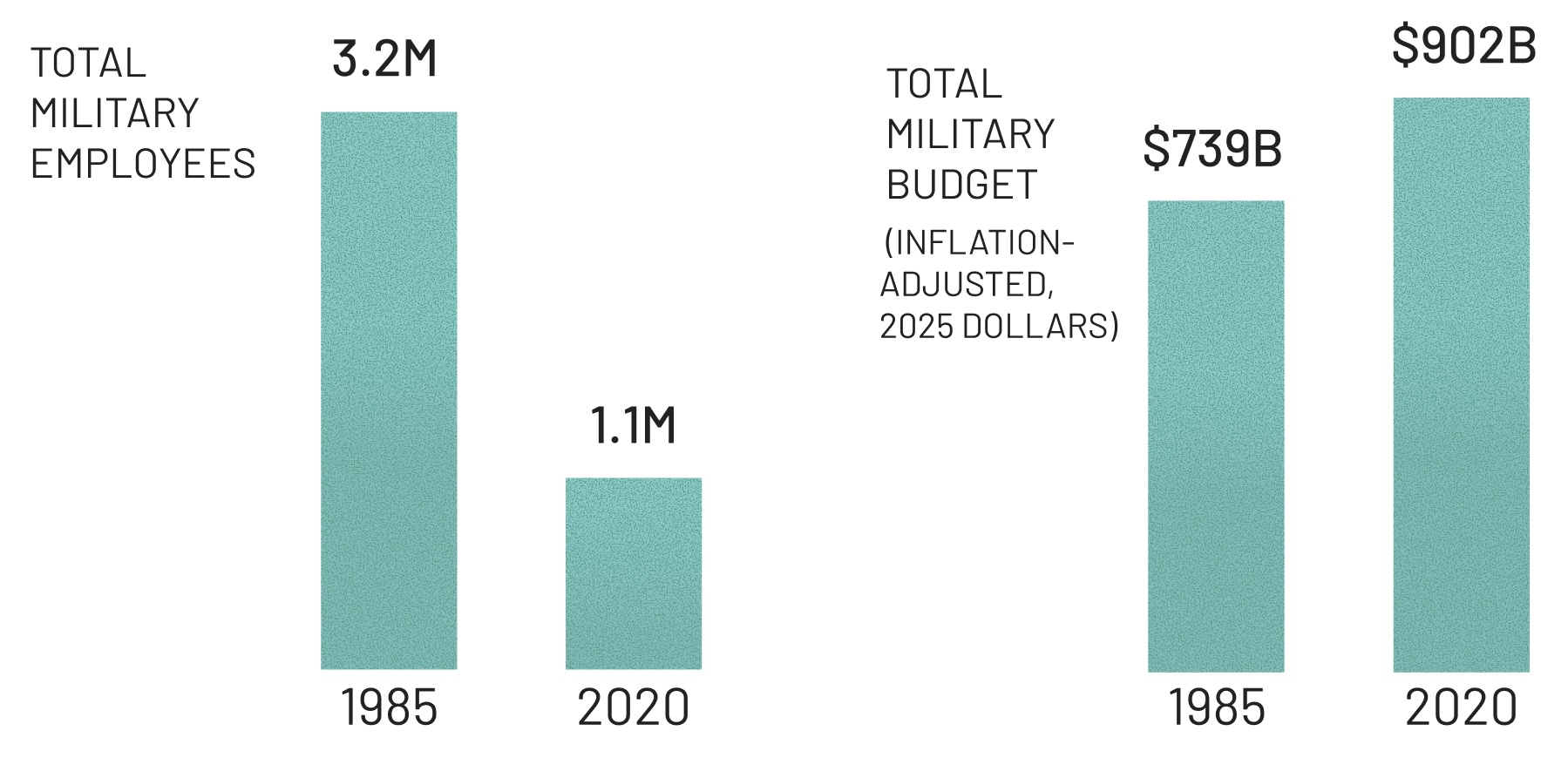
- Inflation-adjusted average salaries dropped from $100,500 to $80,243 over the same period despite jobs in the sector becoming increasingly white-collar. This indicates a particularly sharp fall in wages for the blue-collar workforce. Major military industry contractors cut pensions for workers following the 2008 financial crisis — creating a new generation of employees with more economic insecurity, high turnover, and diminished company loyalty.
- An estimated 10 to 14 percent of the 1.1 million jobs in the private military contracting sector are union jobs.
- Union rates have declined sharply since the Cold War. For example, at least 69 percent of the Lockheed Corporation was unionized in 1971, while the manufacturing sector was approximately 50 percent unionized mid-century. The unionization rate today is 19 percent at Lockheed Martin and as low as 4 percent at Northrop Grumman.
- Labor unions have historically been, and continue to be an important entry point for dialogue around industry reform and alternatives.
Recommended policy directions:
- Cut the military budget: reduce the roughly $1 trillion Pentagon budget to curb global military violence, redirect resources to domestic priorities, and strengthen accountability through stricter oversight and audit requirements.
- Redirect military-industrial capacity to meet urgent needs: shift resources and production from weapons manufacturing toward civilian sectors like green manufacturing, climate mitigation, and care work that create more jobs and broader social benefits.
- Invest in a just transition for arms workers: fund large-scale transition programs that provide retraining, income support, and strong labor protections to ensure workers can move into stable, socially useful industries.
- Curb the influence of the military-industrial complex: reign in the political power of defense contractors by addressing lobbying, revolving-door practices, and campaign financing that skew policy toward corporate interests.
Oppose state and local subsidies to the arms industry: End state and local economic development incentives that subsidize defense contractors to stop duplicative public funding and challenge war-driven economic development at the regional level.