Energy & Industrial Systems
Report
/

A New Era of Manufacturing for Public Good: The Case for the California Grid Manufacturing Initiative 

in partnership with United Autoworkers Region 6, BlueGreen Alliance and the Center for Public Enterprise. 

Read Report

California faces intertwined crises of accelerating climate change and rising cost of living. Major bottlenecks in the supply chain for critical electricity grid components—including transformers, switchgears, and more—delay required grid modernization and stall the deployment of significant renewable energy and battery storage projects around the state. Not only are parts delayed, they have become increasingly expensive, driving up the cost of electricity for ratepayers.

A new state-level bill (AB 2516) would establish the California Grid Manufacturing Initiative (CGMI) to address these challenges and proactively plan ahead to avert supply chain crunches that burden ratepayers and slow the green transition.

The CGMI would have dual purposes. On the demand side, the CGMI would aggregate demand for critical electricity grid components and coordinate procurement to achieve economies of scale and reduce costs for utilities and ultimately ratepayers.
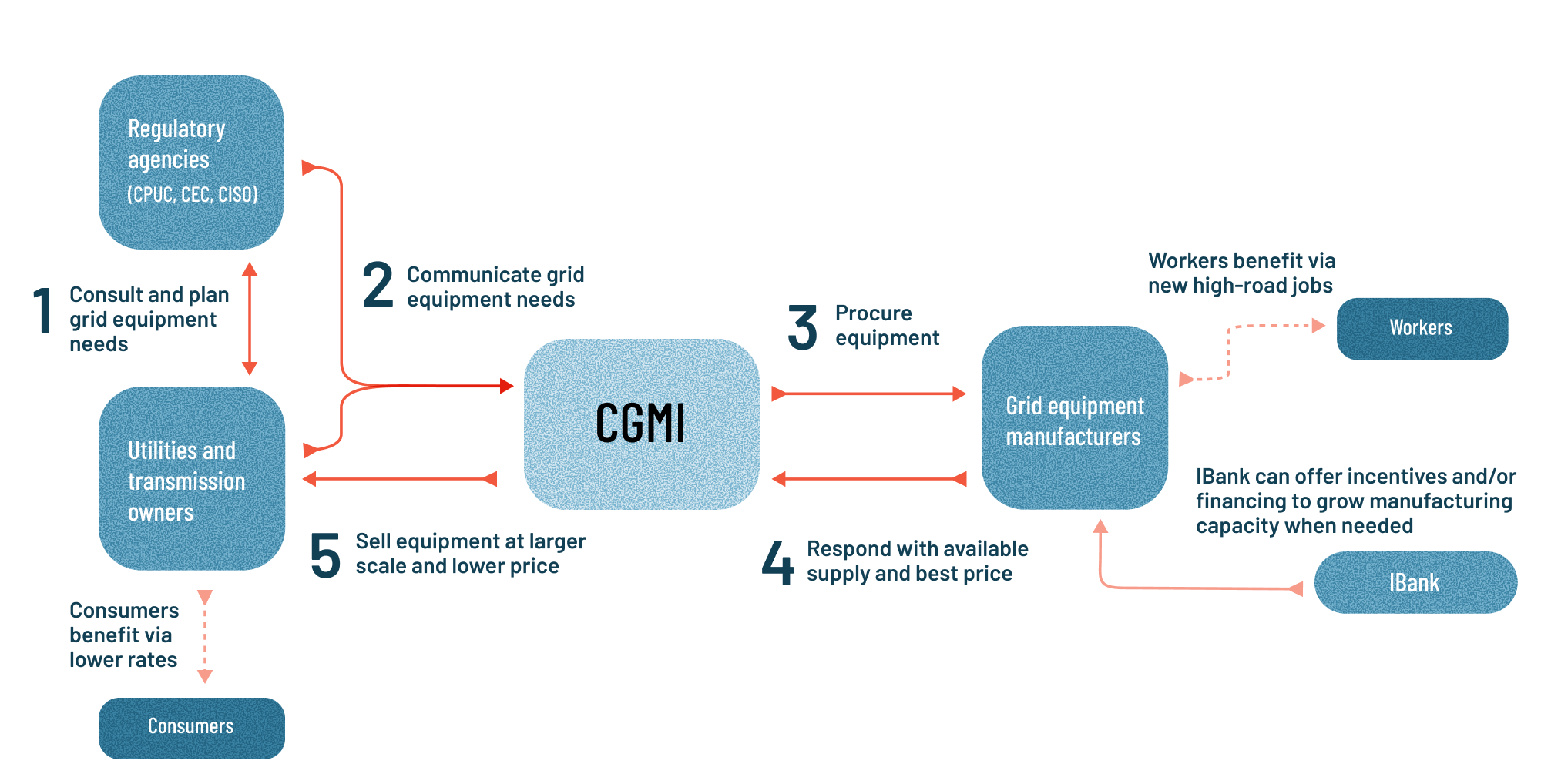
Step 1: *Regulatory agencies (CPUC, CEC, CISO)* consult *Utilities and transmission owners Consult and between them they plan grid equipment needs*  

Step 2: *Regulatory agencies* and *Utilities and transmission owners c*ommunicate grid equipment needs to *CGMI.*

Step 3: CGMI p*rocures equipment* from *Grid equipment manufacturers.*

Step 4: *Grid equipment manufacturers respond with available supply and best prices* to CGMI.

Step 5: CGMI sells *equipment at a larger scale and lower price* to utilities and transmission owners.

California IBank can offer incentives and/or financing to grow manufacturing capacity when needed. Increased manufacturing capacity results in new high-road jobs for workers. 

Utility and transmission owners obtain equipment and lower prices, leading to lower utility bills for consumers.

On the supply side, the CGMI would enter into joint venture agreements with manufacturers to expand or establish new manufacturing capacity in the state—creating high-road, union jobs and easing supply chain shortages with affordable components.
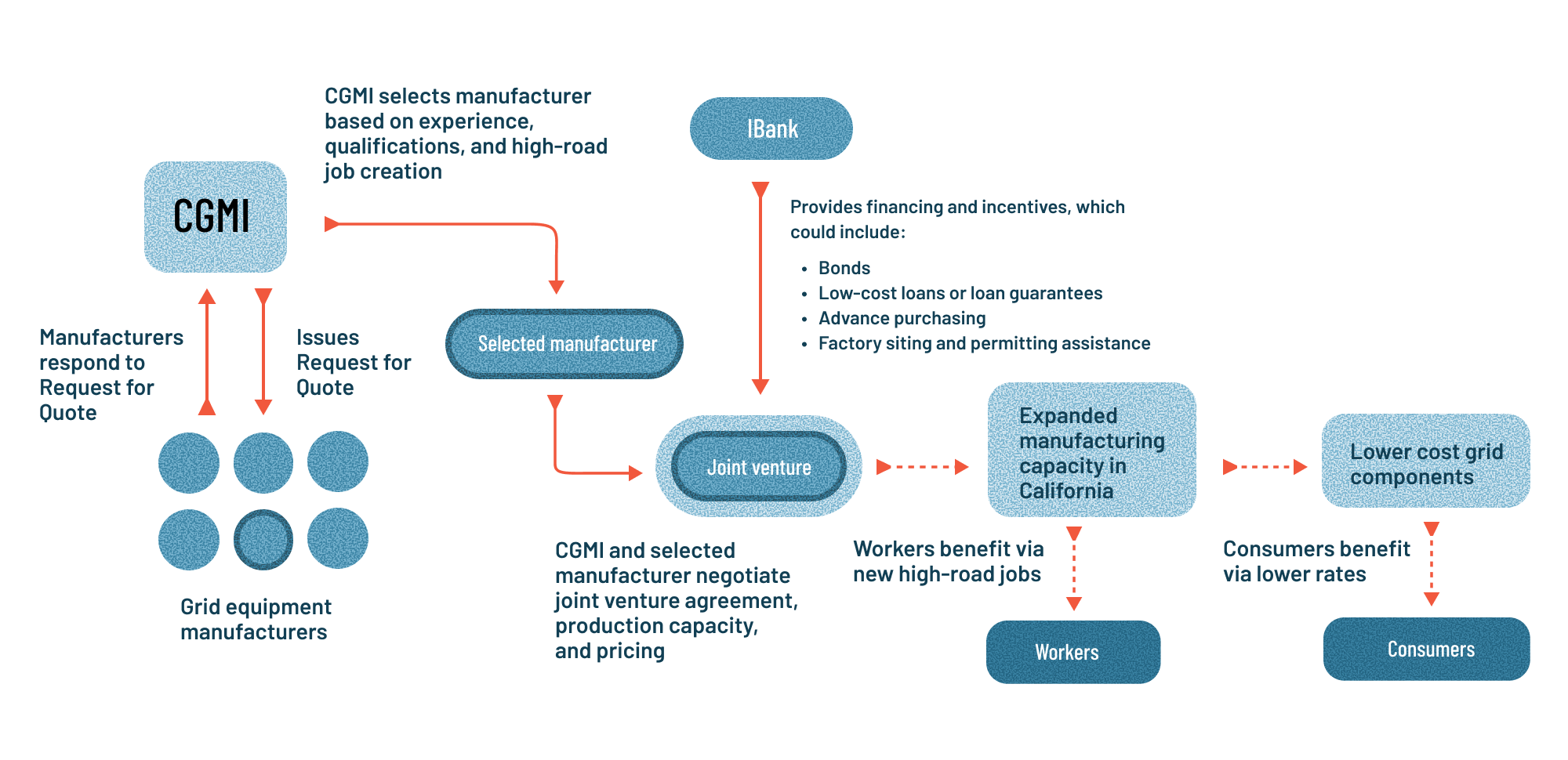
The CGMI issues a Request for Quote to grid equipment manufacturers and manufacturers respond.

The CGMI selects a manufacturer based on experience, qualifications, and high-road job creation. 

The CGMI and selected manufacturer negotiate a joint venture agreement, production capacity, and pricing.

IBank provides financing and incentives, which could include bonds, low-cost loans or loan guarantees, advance purchasing, and/or factory siting and permitting assistance

The joint venture leads to expanded manufacturing capacity in California, benefitting workers via new high-road jobs. 

The expanded manufacturing capacity leads to lower-cost grid components, benefitting consumers via lower rates.

This proactive, state-led approach would yield the following positive impacts:

Ratepayer savings: Modeling shows that resolving increasing grid equipment costs in this sector could save California ratepayers $100—$200 billion cumulatively over the next 25 years. This would amount to $150—$300 in annual savings on utility bills for residential households by 2040 and $500—1,000 per household by 2050.

California industry and economy: Lower-cost electricity increases investment and economic growth. It especially benefits high-tech manufacturing—including industries that could be developed to support meeting California’s climate goals. Modeling on the potential impact on industrial customers shows the potential for $700 million—$1.3 billion in annual savings by 2040 and $2.2—$4.7 billion by 2050 for industrial ratepayers in California.

Lowering the cost of electrical equipment would save California ratepayers up to $200 billion cumulatively by 2050. 
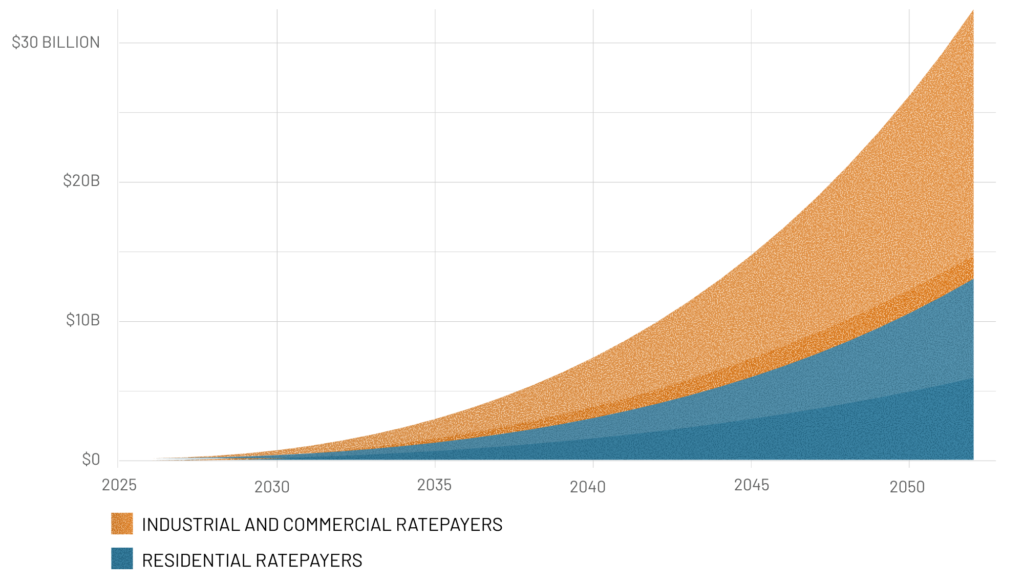
An area chart showing the increasing annual savings to California ratepayers from 2026 through approximately 2052. An orange area representing industrial and commercial ratepayer savings is stacked on top of a blue area representing residential ratepayer savings. Darker colors show a low-range estimate of each category of savings and lighter colors show a high-range estimate. 

The chart shows that compared to a scenario in which electrical equipment costs continue to rise at their current rate, declining costs would lead to $20–$37 billion in cumulative savings by 2040 and $100–$200 billion by 2050, with annual savings growing from $583 million in 2030 to over $26 billion in 2050 at the high end.
The above chart shows a low- and high-range estimate based on two variations of our model. See report Appendix for details.

High-road jobs: Expanding in-state production would create permanent, family-sustaining manufacturing jobs in the process, with up to 12,000 sustained, full-time jobs—including up to 4,600 direct jobs in grid equipment manufacturing as the program is implemented. These estimates are based on in-state manufacturing supplying a portion of in-state demand for grid equipment. If manufacturing supported by this policy grows to export outside of California, the number of jobs should be expected to grow further.

Shifting production to in-state manufacturing could create as many as 12,000 jobs.
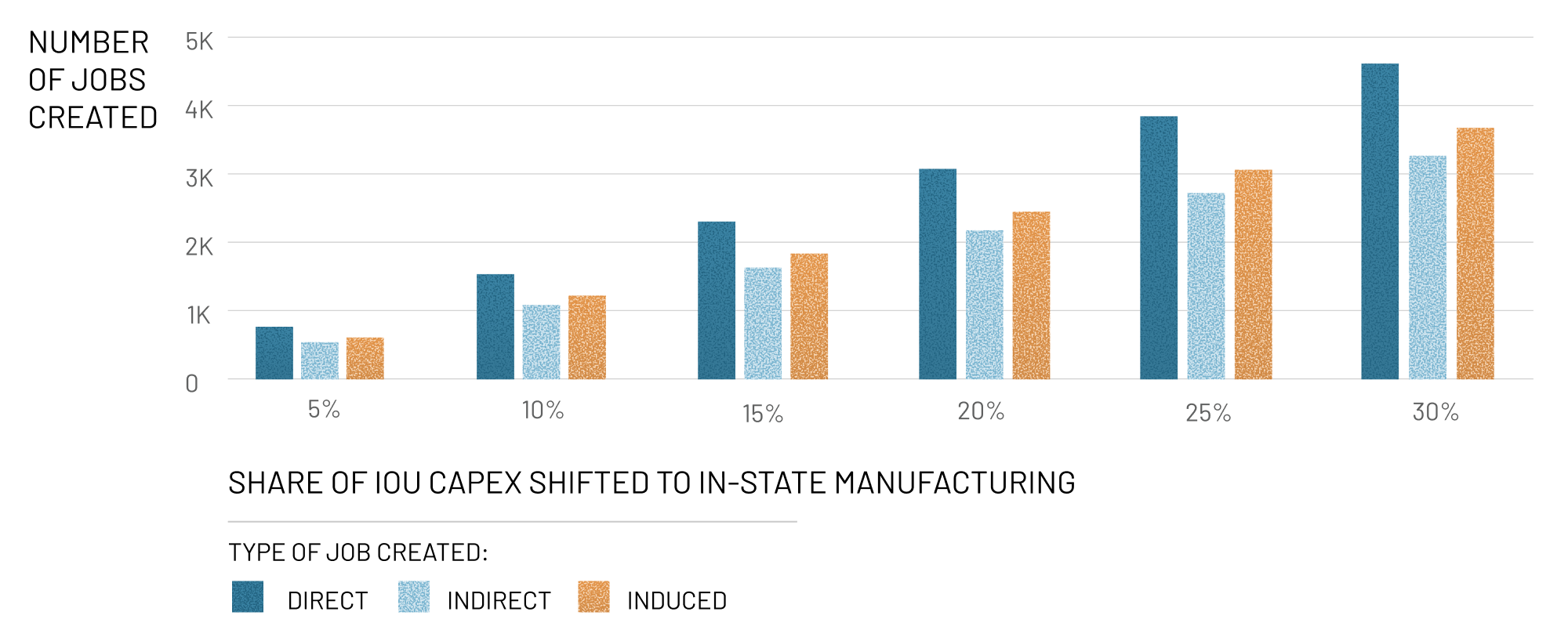
A multiple bar chart shows the following numbers:

If 5% of IOU capital expenditures are met through new in-state manufacturing it will produce 770 direct jobs, 545 indirect jobs, and 614 induced jobs (1,929 total).
If 10% of IOU capital expenditures are met through new in-state manufacturing it will produce 1,540 direct jobs, 1,091 indirect jobs, and 1,227 induced jobs (3,858 total).
If 15% of IOU capital expenditures are met through new in-state manufacturing it will produce 2,310 direct jobs, 1,636 indirect jobs, and 1,841 induced jobs (5,788 total).
If 20% of IOU capital expenditures are met through new in-state manufacturing it will produce 3,081 direct jobs, 2,182 indirect jobs, and 2,454 induced jobs (7,717 total).
If 25% of IOU capital expenditures are met through new in-state manufacturing it will produce 3,851 direct jobs, 2,727 indirect jobs, and 3,068 induced jobs (9,646 total).
If 30% of IOU capital expenditures are met through new in-state manufacturing it will produce 4,621 direct jobs, 3,273 indirect jobs, and 3,682 induced jobs (11,575 total).
See report Appendix for exact figures.

By supporting strategic state-level coordination and intervention, the CGMI increases affordability and efficiency to ratepayers in the capital procurement system and offers an opportunity to build out a green, skilled, high-road workforce in California while accelerating progress to meet the state’s climate goals.


Read Report

Meet the authors